
I previously mentioned that we’re selling our 2017 Tiffin Allegro Bus 40SP motorhome. Which of course leads to the question, what next? Are we still doing the RV lifestyle? If so, what kind of RV will we be getting?
Since moving out of the Tiffin, we’ve been living at our official domicile, Mom’s house in Washington, and have done a bunch of redecorating and nesting.
We have also booked four months (December through March) in a vacation tiny home in Orlando, Florida. We plan to get Disney World annual passes, and spend a bunch of time in the Disney bubble.
Update: alas, the Tiffin didn't sell in time, so we decided to cancel the Florida stay this year. Maybe next year?
Our goal is to spend summers at our home base in Washington, and winters in Florida. We’ll rent in Florida for a year or two, to check if we actually like it, then maybe buy something.
But we aren’t done RVing… we’re just ready for a change in how we do it.
In the months in between those two home bases, we will travel. Plus shorter trips from those locations, too.
We’ve been thinking for a couple of years that we want to downsize to something smaller and simpler (and cheaper to maintain!) than our Tiffin. We’d like to try different styles of camping, like off-grid boondocking and smaller state and national park campgrounds. Having visited all 50 states, we want to explore differently.
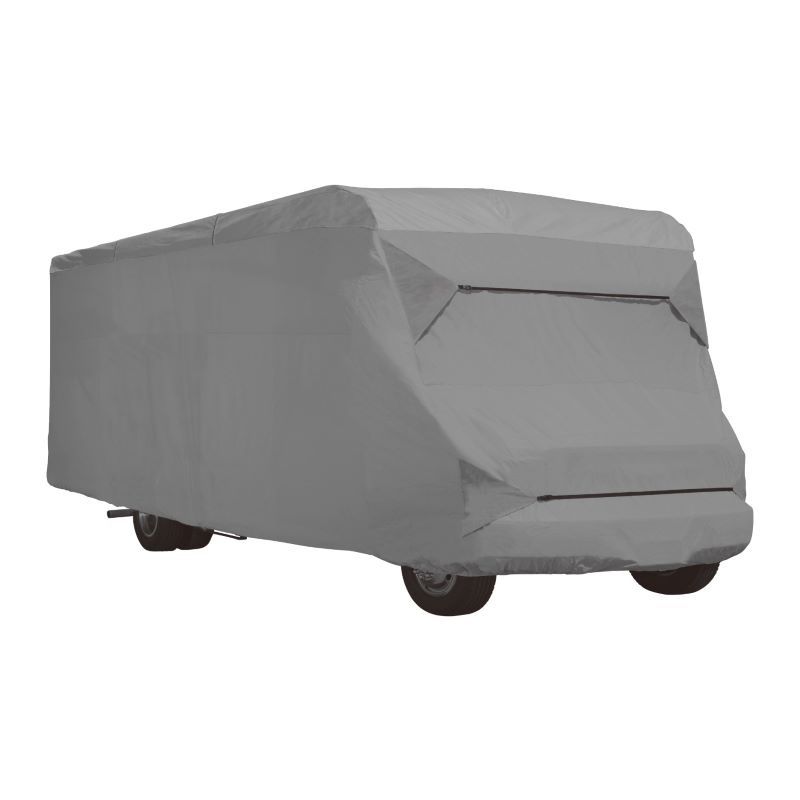
There are various options for the kind of RV to get. The broad categories of RV are towable and drivable.
For a towable, we seriously considered a travel trailer (aka caravan for Kiwi readers) that we could tow behind our pickup truck, before it failed us, but that would have limited us to something fairly small. Or we could have upgraded our truck to one that could tow something larger, but that would be more complicated. We like being able to easily go from the cab of a drivable RV into the house area on travel days, and that's easier on Paladin too.
A fun idea was to get both a small van and a small trailer, so we have the benefits of a van when traveling around and a trailer to sleep in at the campground. But that has some issues — some campgrounds may frown on two campers in one site, and it might be too expensive. Plus it’d be hard to find a van that has the capacity to tow a trailer. It would give us more flexibility, and two bathrooms, so it’s an intriguing notion, but not really realistic.
So if we stick with a drivable RV, and want something smaller than a class A, that means a Class C, B+, or B:
- Class C: A motorhome built on a cutaway van/truck chassis, usually recognizable by the cab-over bunk or storage area. Typically with a boxy coach body that is a bit wider than the cab.
- Class B+: Essentially a smaller, sleeker Class C without the cab-over bunk. Still a cutaway chassis with a separately built coach body. “B+” is a marketing term, not an official RV class.
- Class B: A camper van: the RV is built inside the original van body, such as a Ram ProMaster, Ford Transit, or Mercedes Sprinter. It retains the van's basic body structure.
For our RV trip to Alaska, we had considered trading in the Tiffin for a 30-foot Class C that could tow our truck, but decided to take our Tiffin instead. The truck frame failure probably would have occurred with a Class C too, but such an RV probably would have struggled pulling our heavy truck. There are a few Class C models that we like, but they typically end up around 30 feet long, which is still pretty long, with a lot less power and features than our Tiffin.
We’ve also looked at lots of Class B+ models, and found a few that we like. They tend to be about 25 feet long, so either wouldn’t tow another vehicle, or only a lighter one. But can’t really park in regular car parks, so still would really need a toad.
Another variation that are similar to Class C or B+ models is overlander-type trucks; typically off-road-ready trucks with a separate house box on the back, usually with a small crawl door between the cab and house, typically with a bed above the cab like Class C. These tend to be the highest-priced models, comparable to Class A’s, but with the most flexibility in where they can go. Few have floor plans that appeal to us, but we have seen some we like. But price is a big factor.
Finally, there’s Class B vans. One of the reasons we tried a camper van during our NZ trip was to evaluate that option, which helped us refine our requirements. A van is nice in that it is more nimble; if small enough, it can fit in a regular parking space, and go pretty much anywhere. But such a small van can be very cramped, often with an east-west bed (which means crawling over someone to get out), and a small wet bath (i.e. shower and toilet in one). A larger van is more comfortable, but then it gets too long to fit in a parking space.
However, there are a few vans that check most of the boxes for our requirements and preferences. We decided that one in particular was the best fit for us: the Noovo Plus.
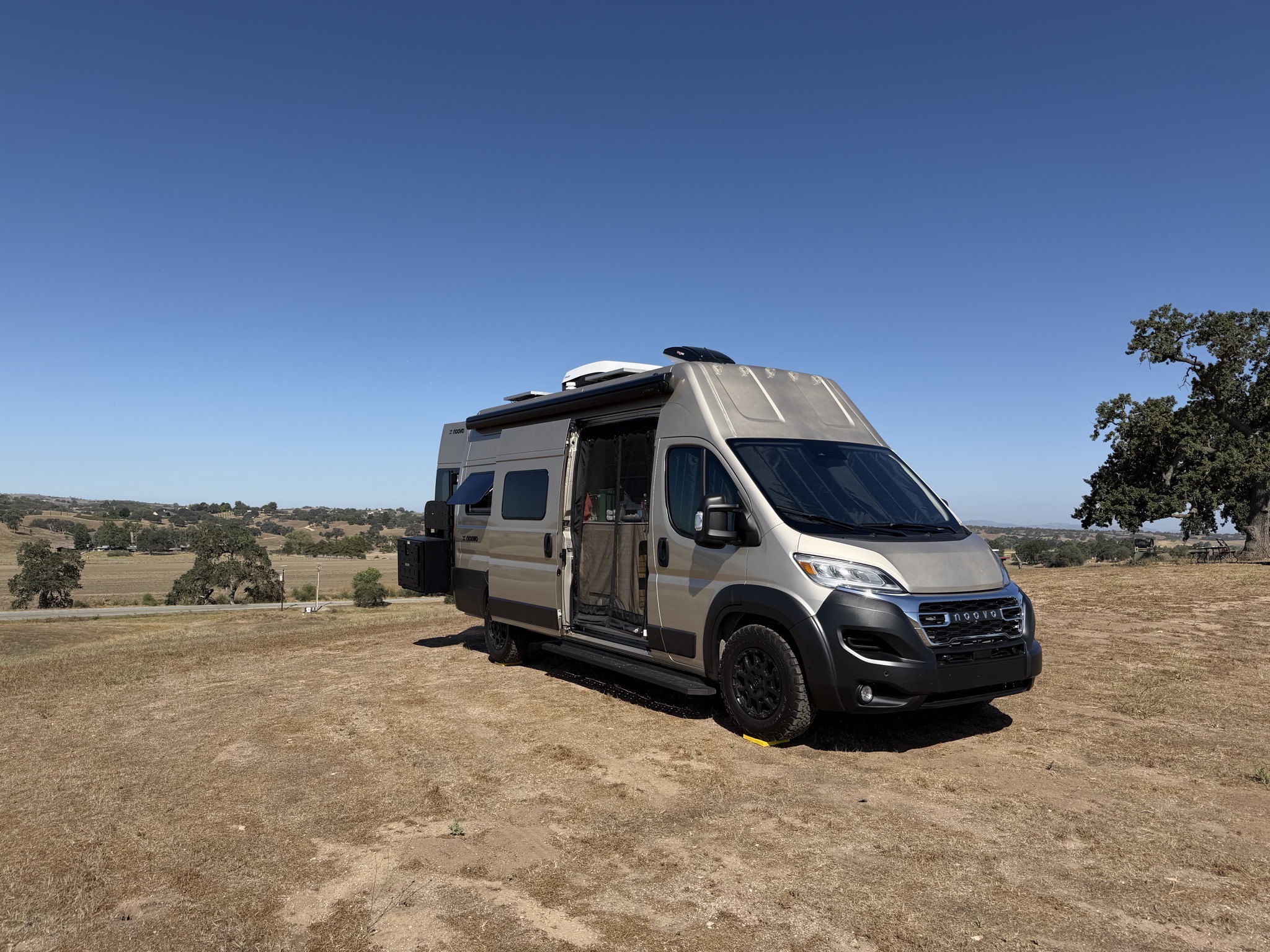
- It is 20 feet 11 inches long, so (barely) fits in most normal parking spaces.
- It has a north-south bed, so we wouldn’t have to climb over each other to get out.
- The bed is on a lift, so can be raised out of the way during the day, without having to re-make the bed each night, and with a large U-shaped lounge below.
- It is very unusual in that it has 7 feet high ceilings inside; I am 6 foot 1 inch tall, so find most vans just barely tall enough, and often have to duck in their showers (Sprinter vans are particularly bad for that).
- It has lots of lithium battery capacity and solar, so no electrical concerns.
- It has no propane, and uses the fuel tank for on-demand air and water heating.
- Decent-size fridge for a van, convection microwave with air fryer, and induction electric cooktop.
- The bathroom is a wet bath, as is typical for vans, but not a bad size, and no shower curtain required (the curtain in our NZ van made that unusable for us).
- By default it has a cassette toilet, but can be optioned with a dry flush toilet, which would enable staying off-grid longer. We are currently leaning towards that option.
- It is on the Ram ProMaster chassis, which is gas powered and less expensive to maintain than a diesel system like Mercedes Sprinter (though also not as comfortable).
- The build quality, aesthetics, support, and community are top notch.
So once we decided to sell our Tiffin, we decided that a Noovo Plus van will be our first choice for our next RV. The Tiffin hasn't sold yet, so our plans are subject to change. Regardless, we are committed to buying a smaller RV, since we can’t flat tow the Honda CRV we recently bought. Our current plan is to take that to Florida as a daily driver, and store it there while traveling the rest of the year.
If you’re interested, you can learn more about the van and try the build options via the Noovo Plus product page.
We’re excited for the possibilities of van life, and our new combination of splitting each year between staying in two home bases while still traveling for months each year. Should be a nice variety — the comfort of familiar surroundings along with the fun of exploration and new experiences.
Now we just need our Tiffin to sell, so we can finalize our plans!