A timelapse of driving our RV, a Tiffin Allegro Bus motorhome, 269 miles from Marathon, Texas to Junction, Texas.
Travel from Marathon to Junction, Texas
We drove our coach 269 miles, about five hours of driving, from Marathon, Texas to Junction, Texas.
The map route, heading north then east:

Firstly, a video of retracting the front driver-side slide-out:
Our coach with the slides in, and the truck hooked up, ready to leave:

Paladin went straight down the steps, so I left the step cover open:

Some fairly barren hills; compare to later pictures:

Heading north:

Roadworks; narrow lanes are a little disconcerting in a wide coach:

More roadworks:

Joining I-10 to head east:

Roadrunner mural:

“Cud you not text and drive?” There were several amusing cow-themed billboards like this:

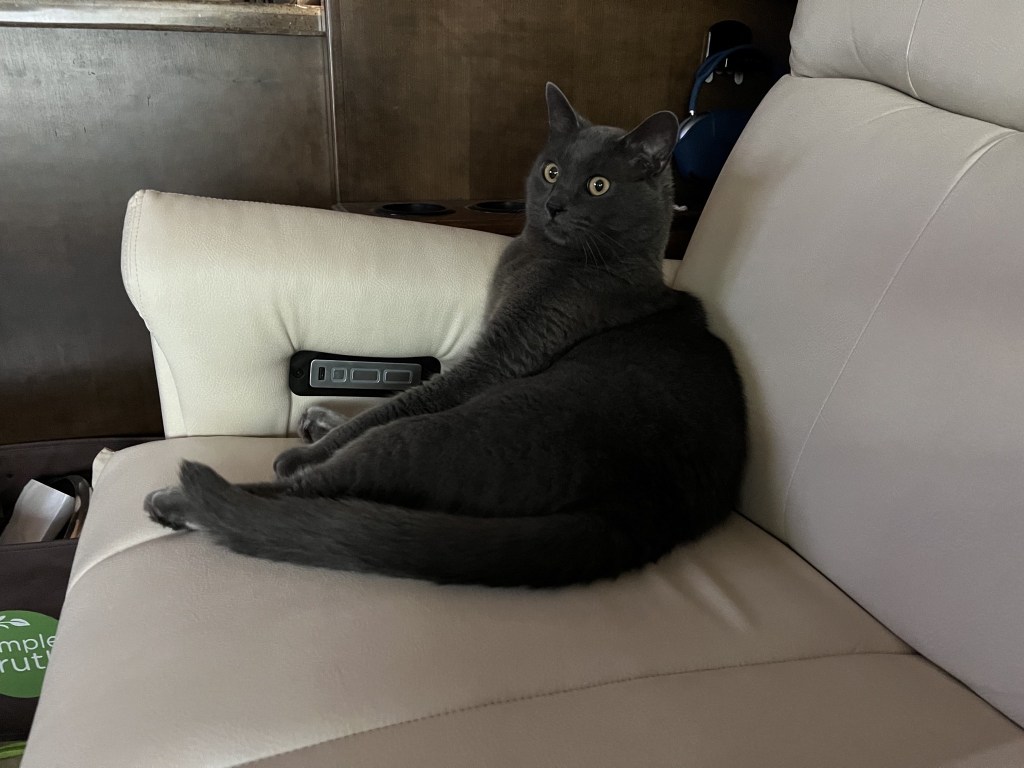
Paladin still on the steps, enjoying the view out the cat window:

We stopped at a roadside picnic area for lunch:

Since the step cover was open, I hopped out to stretch my legs. Here’s an old stagecoach stop:

Our coach:

Paladin on the back of the couch during lunch:

An interesting mountain:


We stopped again, at a parking area (there are various kinds of stopping places: a rest stop has bathrooms, a picnic area has tables but no bathrooms, and a parking area doesn’t have any amenities… which is fine for us, being self-contained):

Our coach:

Road Ranger fuel stop:

There was both the Road Ranger truck stop and a Love’s fairly nearby; we would normally have gone for the Love’s, but the Open Roads app indicated that Road Ranger had a much better discounted fuel price:


A river, and a lot more greenery; we’re out of the desert now:

Our exit:

Our destination, Pecan Valley RV Park and Farm, nestled behind a pecan tree farm:


Chick-in:

Guided to our site by the owners:

I started this post with a picture of our coach ready to leave; let’s end with our coach just arrived, before putting the slides out:

RV fire safety
Fire safety is an important consideration for everyone, especially RVers, with lots of combustible materials in a small space. There have been lots of stories of RVs that have burned to the ground — usually cheaper trailers with propane fridges, but any RV is at risk.
Especially since RVs typically come with just one mandated fire extinguisher, by the door (which I invert and shake once a month, to prevent the contents settling):

If we’re in our bedroom when a fire starts, that extinguisher may not be overly useful — if we can get to that one by the door, we should probably just get out the door, unless the fire is tiny.
So a basic first step is to get a second fire extinguisher for the bedroom, which we keep in a cabinet above the bed:

But we can do better than that. We have purchased several quick can-style fire suppressors, which not only can put out fires, they produce a foam that we can spray onto ourselves if we have to go through flames to get out:

We have several of them all around the coach, including in a cupboard in the kitchen and under the kitchen sink:

In the bathroom cabinet:

And in several compartments in the basement area:


The coach came with a smoke detector in the cockpit area, but we felt that wasn’t enough, so we got some smart Nest Protect ones, that do both smoke and carbon monoxide detection, and talk to each other:

I mounted one in the living room area, and another in the bedroom:


Plus a third in the basement, to detect any fires down there:


The Nest detectors weren’t compatible with our Wi-Fi network, so I also got a Nest Wi-Fi router to help set them up (once set up, they communicate with a private network, so they’re not dependent on Wi-Fi):

The Nest router is installed in the internet cupboard, with an Ethernet connection to the Pepwave modem:


Our coach only has one entrance door. If we’re in the bedroom and a fire blocks access to that door, there is an emergency exit in the bedroom window; the red latches can be opened to swing the whole window up:

It’s a fairly small emergency exit, but better than being stuck back there. To make it easier to use, I got a pole that lives next to the window:

The pole can be used to hold the emergency exit open, for easier egress:

Hopefully we’ll never need to use it, but it should help if needed.
Big Bend National Park
We spent a day visiting Big Bend National Park in Texas, our last national park for the year, and our last new one until we visit Death Valley in March.
An interactive map of our route:
Entrance sign:

Persimmon Gap Visitor Center near the northern entrance:

We asked the ranger about picnic spots; he told us about a secret picnic spot that isn’t normally mentioned, since they don’t maintain it; a couple of shelters, but just one table. So we had a picnic lunch there:

Hazy mountains and views:


Panther Junction Visitor Center, which includes a post office:

You know I enjoy relief maps:


Gift store:


There’s even a gas station, very unusual for a national park:


Chisos Basin Visitor Center:


Window View Trail:


The Window:


Hole in a rock:


Castolon Visitor Center area:


Old barracks from 1919, that burned in 2019:


Moon over mountains:


A scenic drive.
McDonald Observatory Star Party
In addition to the little star party at our RV park, we also attended a larger star party at McDonald Observatory in the mountains north of Fort Davis, Texas.
It was a little cloudy, and the moon was about halfway, neither of which made for ideal viewing, but it was fine for viewing bright objects like the moon and planets.


The evening started with an introduction and constellation tour in an outdoor amphitheater:


Then everyone lined up to view selected targets via some telescopes, including the moon, Mars, Jupiter, and Saturn:


We then headed to the visitor center, and looked at their exhibits:


And of course the gift store (though shockingly didn’t buy anything):

Back outside:


A different experience than the campground star party; not as personal, more waiting, but more clear views through the telescopes. I’m glad we did both.
Power Watchdog dimmer shade
I mentioned in my review of the Marathon Motel & RV Park that the Power Watchdog was too bright for a dark sky park:

Here’s a nighttime pic from an earlier campground:

As a temporary measure, I covered it with a bit of cardboard:

But I also ordered a better solution — a self-adhesive dimmer shade from the manufacturer:

Here it is with the shade added:

At night, the light is still visible, but much less bright (this is a night mode pic, so looks brighter than in person):

A non-night-mode pic:

Gage Gardens
A surprising hidden gem in Marathon is Gage Gardens, a 27-acre park tucked away across the railway tracks from the downtown shops.


Rose garden, dormant in winter:


Lots of grasshoppers:


A painted cow:


A delightful garden in a delightful town.
Marathon Sky Park Star Party
Our neighbor at the Marathon Motel and RV Park hosts a star party each clear night, where he and another guy talk about the moon, planets, and stars, and show several of them through a couple of telescopes and high-powered binoculars for anyone interested (no reservation required, other than big groups).
A sign for the star party by the office:

The motel has a large area set aside for telescopes, with several concrete pads and a couple of small domes, plus a shed for a bigger telescope:

Our host, setting up the bigger telescope:


A photo of the moon, taken through the smaller telescope; rather blown out, but you can see the craters and mountains at the terminator line:

Sunset:

A bunch of people for the star party:

Using a powerful laser pointer to indicate stars:


People at the binoculars:

The two telescopes:

It was an enjoyable and fascinating experience. And so convenient, a short walk from our coach.
Marathon, Texas
We really liked the small town of Marathon in Texas (Wikipedia page). It has a population of just about 400, and was established in 1882.
We had lunch at the V6 Coffee Bar:


The one grocery store in town, The French Grocer, is pretty tiny and expensive, but had the essentials:


With cute little grocery carts, too:

They also had a wide selection of ciders; we bought four Texas Keeper bottles:

More buildings around town:


A train track goes through the town:

The post office:

A painted sign next to the post office:

Foot bridge:

Rail tracks:

Another foot bridge:

More buildings:


Texas etched in footpath:


Another day, we had dinner at Brick Vault Brewery & Barbecue:

Outside seating:

Inside:

Menu:

Bar:

The building used to be a Gulf gas station, established in 1939:

A view outside:

Our dinners, all very tasty:

And desserts, also tasty:

Outside:

Fire station:

Windmill:

Church:

Historic house:

Shops:

The Gage Hotel is the main feature of the town, in fact they own several other businesses around town:

On the road next to the RV park, an amusing UFO sign:

On our last day, we stopped by Big Bend Pizza:


A cute town. We’d be happy to visit again.
BlueFire diagnostic adapter
Vehicles nowadays are full of computers that control and monitor most operations. You may know about the data port that repair shops can use to diagnose issues. This port can be used by us, too.
The BlueFire data adapter connects to a different style of this port in large vehicles like trucks and motorhomes, and uses Bluetooth to communicate with an app to display this diagnostic information.
Here’s the adapter next to the case it came in:

Top of the adapter:

The connector on the bottom:

There are two data ports under the dash in our coach; the green one is the modern data port; I’m not sure about the gray one; might be an older port, or something else:

Removing the cap from the port, you can see the connector pins:

The BlueFire adapter plugs in, with a twist to lock it in place; it lights up with various colors and flashing patterns for its status:

The other essential part is the app. It works on Apple iPads and iPhones, and Android devices. It has a dashboard that can be configured; see the BlueFire site for more examples.
Here’s a dashboard layout I used initially on my iPad Pro (I’ve actually been using the BlueFire for months, but just got around to writing about it):

I later changed to a different layout that I got from someone online:

I have my iPad on the dash of our coach on travel days, along with the tire pressure monitor, and my laptop with the map:

I’m still working on improving the dash layout in the app; I’ve added a couple of gauges, but there’s room for more:

Here’s a screenshot for a more clear view:

Sometime I’ll spend more time customizing this further, but it’s a useful tool as-is.